Main Research Topics
PhotonXLab collaborates with several national and international groups and focuses on the following research areas:
Mode locked lasers and applications | Semiconductor lasers and amplifiers
Mode-locked lasers (MLLs) is a family of well established laser sources that are widely used as a source of ultrashort pulses (from tens of picoseconds down to few tens of femtoseconds) for scientific, medical and industrial applications.
Our research is focused on fiber and semiconductor sub-families of MLLs which continue to attract substantial interest thanks to their ease of operation and small footprint. In particular our research includes the following topics:
- Multi-wavelength emission (which is interesting in view of applications in fields such as difference frequency generation, pump-probe measurements, remote sensing, THz sources, etc.)
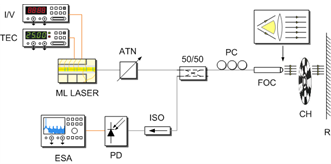
- Influence of optical feedback on the stability and noise of MLLs.
- Mutual coupling and synchronization of MLLs for application such as pulse synthesis, clocks etc.
- Novel principles and new applications for laser based sensors
- Modelling, simulation and applications of semiconductor lasers and SOAs. We investigate fundamental properties of semiconductor devices in view of performance improvement and emerging applications.


Earthquake detection by commercially deployed fiber cables
The use of fiber infrastructure for environmental sensing is attracting global interest, since the optical fiber is an easily accessible platform with a large terrestrial coverage. Moreover, optical fiber networks offer the possibility to access submarine areas where the permanent use of other types of sensors is difficult or expensive.
In collaboration with research groups from the Univ. of West Attica, the Institute of Geodynamics (NOA), Univ. of Athens, OTE, ETH Zurich, we have demonstrated detection of seismic waves by means of Microwave Frequency Fiber Interferometry (MFFI) installed on commercially deployed fiber cables in three field experiments conducted in Attika and Kefalonia island (Greece) from 2022-2025. We have demonstrated the ability of the system to capture and record weak earthquakes, tides and sea waves. Ongoing developments target the improvement of the system in terms of several characteristics (sensitivity, noise, magnitude and epicenter localization, etc.)
Photonic Sensors
Light opens up a wide range of possibilities for metrology and sensor technology (optical fiber sensors, planar waveguide sensors, laser-based sensors, biophotonic sensors, etc.).
We are interested in novel principles for optical sensing and in developing new sensing applications. Our research currently includes displacement, vibration and stress sensors that can be used in a variety of scenarios and applications. In addition, we are interested in applications of Fiber Bragg Grating sensors in constructions and biomedical fields.